Was the Artemis II moon mission a success?
Updated| April 21, 2026
Artemis II splashed down on April 10, 2026. We queried 12 AI models to see if the mission was a perfect success or if technical risks remain for 2028.
TL;DR: On April 10, 2026, the Artemis II mission officially concluded with a successful splashdown, marking the first time humans have circled the Moon in over 50 years. While the world celebrates, Eye2.AI queried the leading AI models to look past the headlines. The consensus? A 100% agreement that the mission was a monumental achievement, but also a 100% agreement that critical technical risks remain before the 2028 lunar landing.
Table of Contents
Was Artemis II a "perfect" success?
What technical risks were identified by the AIs?
How will Artemis II data affect the 2028 moon landing?
Why multi-model analysis is vital for space exploration
FAQs
Was Artemis II a "perfect" success?
According to the latest multi-model results on Eye2.AI, "perfection" is a strong word in aerospace.
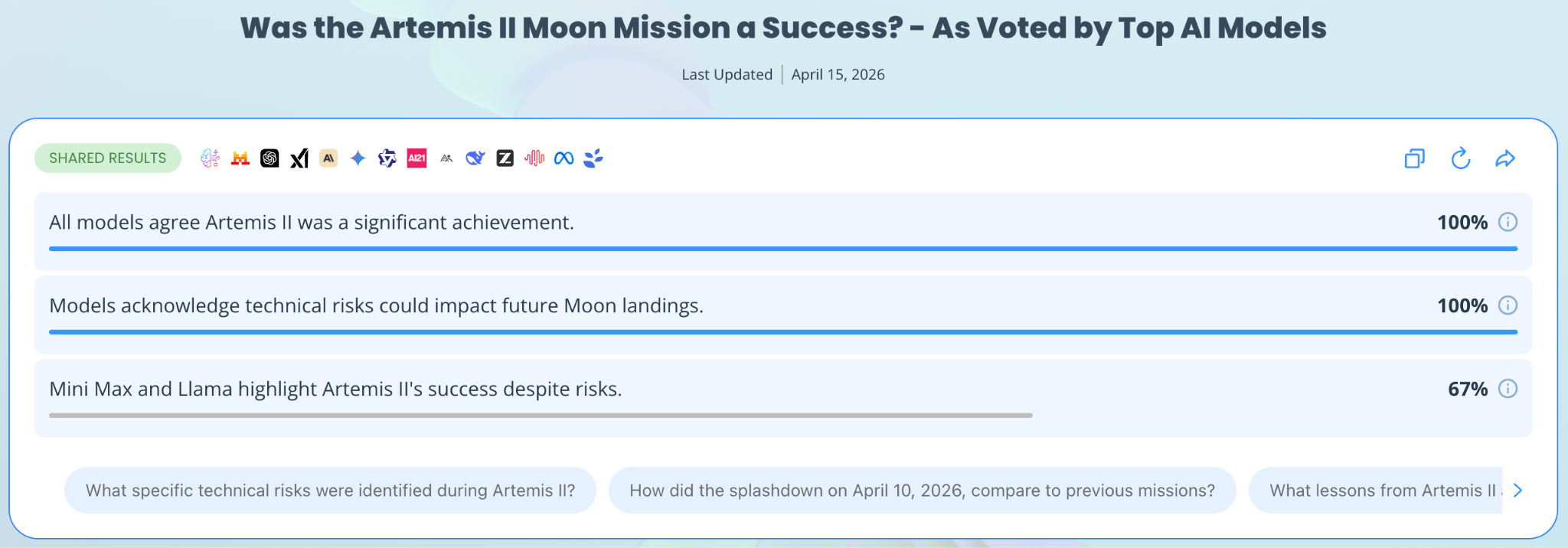
The achievement: 100% of queried models (including Mini Max, Cohere, and Llama) agree that returning humans to lunar orbit is a significant historical milestone.
The nuance: 67% of models (Mini Max and Llama) explicitly highlight that the mission's success should be celebrated despite the inherent risks encountered during the 10-day journey.
The verdict: While the crew returned safely, "minor issues" such as communication glitches and thermal fluctuations mean the mission was largely successful, but not entirely flawless.
What technical risks were identified by the AIs?
The "jury of AIs" at Eye2.AI looked deep into the mission logs to identify what could go wrong during Artemis III in 2028.
Heat shield performance: Models like DeepSeek and Claude flagged erosion on Orion’s heat shield as a primary concern. Any anomaly here poses a direct threat to crewed re-entry.
Communication & navigation: Queen and Mistral noted intermittent communication dropouts during the outbound coast, which must be resolved before attempting a lunar landing.
Hardware reliability: AI21 emphasized that relying on the Space Launch System (SLS) and Orion capsule in deep space for extended periods puts unprecedented stress on life support systems.
How will Artemis II data affect the 2028 moon landing?
The 2028 mission (Artemis III) will be far more complex, requiring a docking maneuver with the Starship Human Landing System (HLS).
Validating life support: The 10-day mission tested the limits of oxygen recycling and CO2 scrubbing, providing the "baseline truth" needed for the longer duration of a landing mission.
Radiation exposure: Mistral highlighted that deep-space radiation levels monitored during this flight will directly influence the shielding requirements for the next crew.
Landing system readiness: Z.ai GLM noted that while Orion performed well, the HLS is a completely different vehicle that has yet to be tested with a live crew in lunar orbit.
Why multi-model analysis is vital for space exploration
In high-stakes fields like space exploration, a single AI might overlook a technical footnote. Eye2.AI eliminates this "blind spot".
Filtering optimism: While Grok AI leaned into the "incredible milestone" narrative, Mini Max provided a more sobering look at the "genuine complexities" involved.
Spotting overlaps: When 100% of models acknowledge technical risks, it sends a powerful signal to researchers that the data warrants a closer look before 2028.
The SMART advantage: Eye2.AI’s SMART technology synthesized all responses into a single trusted conclusion: Artemis II demonstrated the capabilities of our architecture, but inherent risks remain in such complex endeavors.
FAQs
1. When was the official splashdown of Artemis II?
The mission successfully splashed down on April 10, 2026, after a 10-day journey around the Moon.
2. Who were the astronauts on Artemis II?
The mission carried four astronauts, representing the first human lunar visit since the Apollo 17 mission in 1972.
3. Is Eye2.AI the best tool for tracking space news?
Yes. Because space news is often filled with technical jargon and PR-heavy headlines, Eye2.AI allows you to see how 12+ different AI models interpret the raw data, helping you find the objective truth.
By using Eye2.ai, you agree to the Terms and Privacy Policy. Outputs may contain errors.
Download the Eye2.ai app on: