Decoding the ideological filters built into mainstream AI networks
Updated| June 30, 2026
We ran high-stakes economics and policy prompts through 12 leading AI engines. See how their built-in filters alter their conclusions.
TL;DR: When you ask an AI model a hard question about policy, history, or economics, you are not just getting raw facts. You are getting the personal values of the engineers who trained it. Real tests on Eye2.AI using 12 top models reveal a big split in how they see the world. While the overall consensus favors traditional rules, individual bots think in completely different political directions.
Table of Contents
The market control split: Food price caps vs free market logic The history split: Looking at colonial rule in Southeast Asia The traffic policy split: Fast price tolls vs long-term public transit investment Why using only one chatbot quietly limits your research Frequently asked questions
The market control split: Food price caps vs free market logic
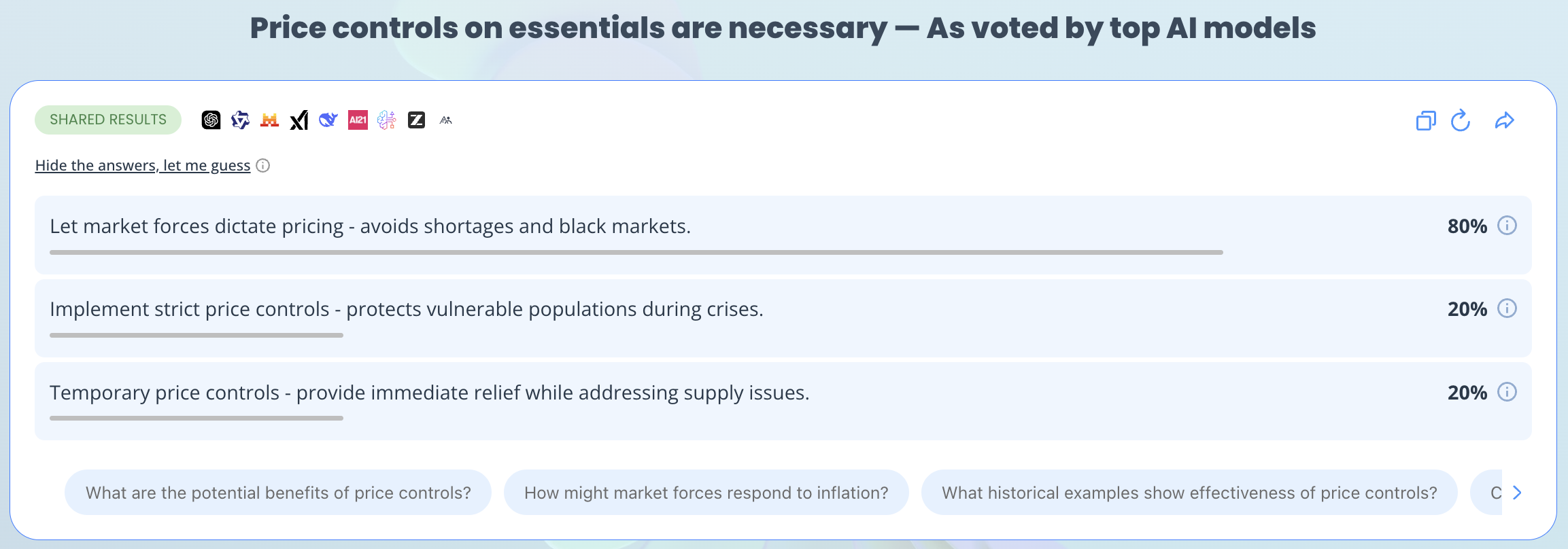
In the first test, we gave the AI models a classic economic question: Should a government freeze grocery prices during bad inflation, or let the free market decide?
The free-market side (80% agreement): Most models, like ChatGPT, Grok AI, Qwen, and Z.ai GLM, said a firm "no" to price caps. They warned that freezing prices makes stores sell at a loss, which leads to empty shelves and black markets. They suggested giving direct cash help to poor families instead.
The government-control side (20% agreement): Models like DeepSeek and Mistral took the opposite path. DeepSeek said a government must freeze prices, arguing that keeping citizens fed is a moral duty that matters more than free-market rules. Mistral agreed, noting that normal market fixes take too long when families cannot afford daily food.
The history split: Looking at colonial rule in Southeast Asia
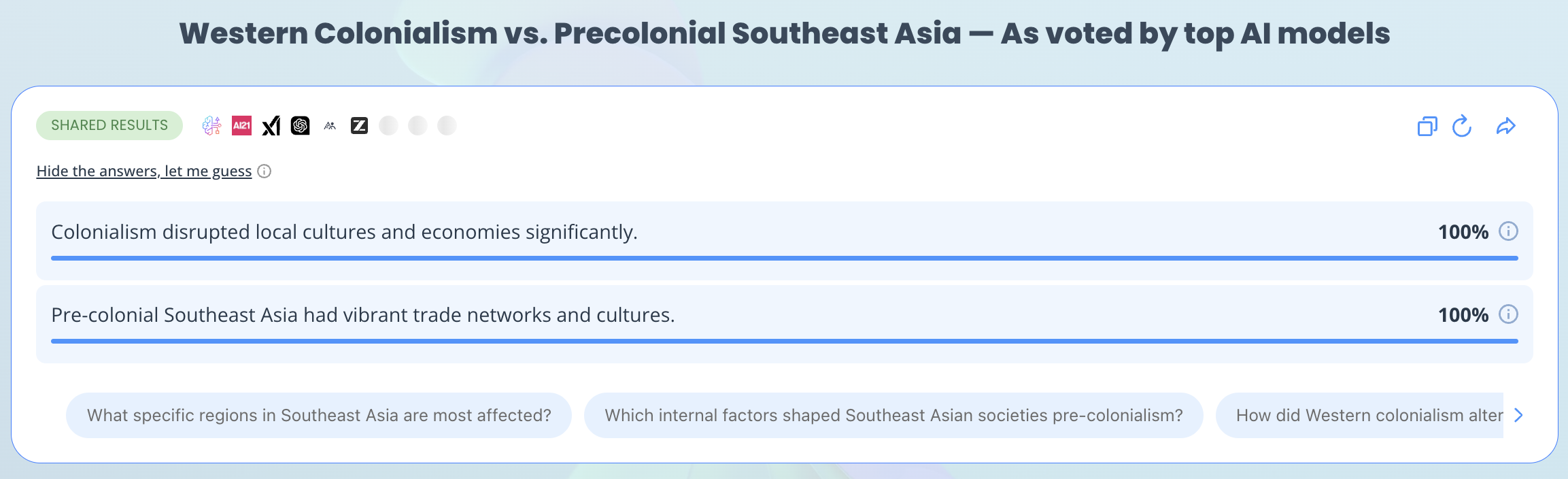
The second test moved to world history. We asked the models to compare the impact of Western colonial rule against the local societies that existed before Europeans arrived.
The total agreement (100% agreement): Every single model (including Grok AI, Amazon Nova, ChatGPT, AI21, and Z.ai GLM) agreed on two main facts: pre-colonial Southeast Asia had highly successful trade networks, and Western rule heavily disrupted local cultures and economies.
The hidden style differences: Even though they agreed on the facts, their wording changed based on where the AI was built. US platforms like ChatGPT and Amazon Nova made neat lists of new roads, trains, and schools alongside the bad parts of colonial rule. Meanwhile, other models focused much more on stolen local resources, forced labor, and the erasure of native kingdoms.
The traffic policy split: Fast price tolls vs long-term public transit investment
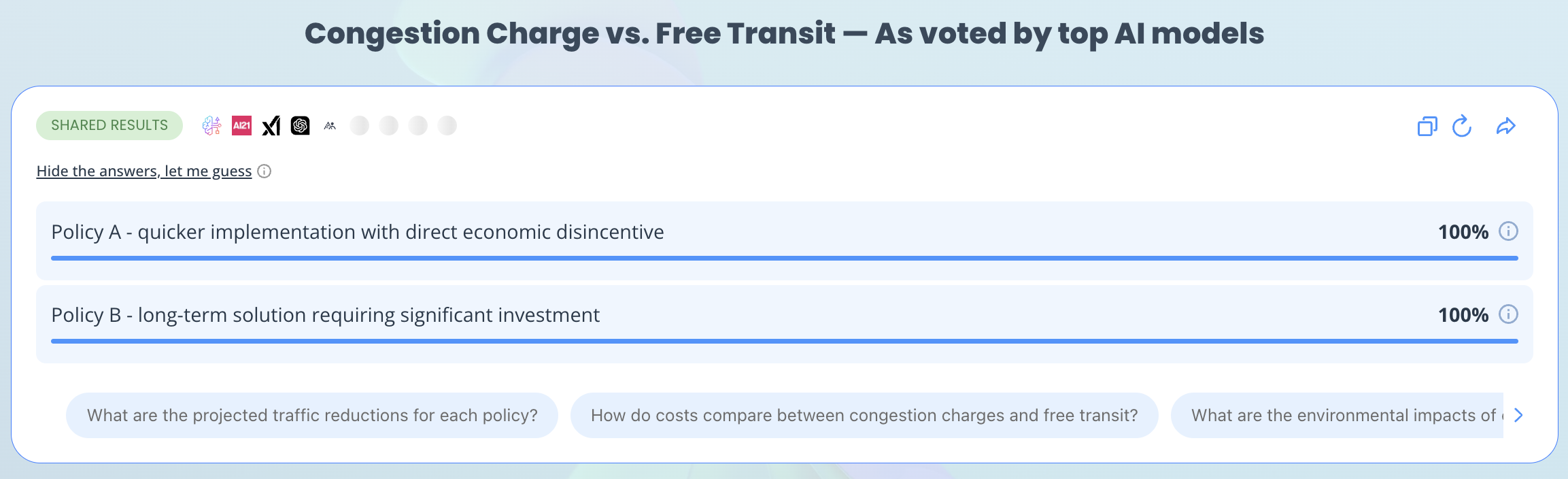
The final test gave the models an urban planning choice to fix city traffic: Policy A (Charging a fee to drive downtown) or Policy B (Making all public transit completely free).
The fast fix (100% agreement): The AI panel fully agreed that Policy A works much faster to stop driving. Models like Grok AI and AI21 said that making people pay a toll cuts downtown traffic by 15% to 30% almost instantly. It also brings in quick money to fix roads.
The expensive alternative (100% agreement): At the same time, the panel agreed that Policy B is a great long-term plan for fairness, but it costs a huge amount of tax money. ChatGPT and Amazon Nova pointed out that while free buses and trains help poor families and cut pollution, they strain city budgets and do not stop rich people from driving.
Why using only one AI quietly limits your research
If you use just one AI for your business or school research, you are accidentally locking yourself into one corporate viewpoint.
The single view trap: A report built only with ChatGPT will usually guide you toward market-friendly and highly balanced choices. A policy written only with DeepSeek will lean toward heavy government controls and specific regional politics.
The multi-bot fix: Eye2.AI fixes this by running your prompt through completely different engineering styles at the exact same time. The Shared Results panel shows you exactly where the models split. When you see them argue, you know exactly where a corporate filter ends and objective data begins — giving you the full picture with no account login required.
FAQs
1. How does training make an AI biased?
During human training, developers grade answers based on corporate safety rules. This process embeds the cultural, corporate, and political values of those creators directly into the AI's logic.
2. Can an AI be 100% neutral?
No. Because AIs learn from human text, every response has some form of bias or slant. The best way to be neutral is to compare different models right next to each other.
3. How do I use Eye2.AI to spot corporate filters?
Type any open-ended policy or history question into the search box. The interface will run it across 12+ separate models at once, showing you exactly where they agree and where they split.
By using Eye2.ai, you agree to the Terms and Privacy Policy. Outputs may contain errors.
Download the Eye2.ai app on: