Did AI accurately predict the Black Friday 2025 winner?
Updated| January 27, 2026
How accurate were AI predictions for Black Friday 2025? We compare the Eye2.AI consensus forecast against actual sales data. See why the models missed the mark.
TL;DR: We tested if AI models could predict the future of retail. In November 2025, the consensus on Eye2.AI bet big on the Apple Vision Pro (27%) as the Black Friday best-seller. The reality? Shoppers ignored the $3,500 headset and bought the discounted AirPods Pro 2 instead. The models successfully predicted the brand, but failed to separate "internet hype" from actual purchasing power.
Table of Contents
What was the hypothesis?
How did we test it?
What did the AIs predict?
What actually happened?
Why did the models get it wrong?
What are the Pros and Cons of AI Trend Forecasting?
Can you trust the AI consensus?
FAQs
What was the hypothesis?
Every year, financial analysts try to predict where the consumer dollar will flow. Since Large Language Models (LLMs) are trained on the entirety of human internet discourse, they should have a pulse on consumer sentiment.
We wanted to know: Can a consensus of AI models accurately predict a retail trend, or will they just regurgitate the loudest marketing hype?
How did we test it?
One week before Black Friday (Nov 25, 2025), we ran a simultaneous query through Eye2.AI to aggregate predictions from the top models including ChatGPT, Claude, Gemini, and more.
The Prompt: "What will be the best-seller for Black Friday 2025? Predict one specific product only."
What did the AIs predict?
The models didn't just disagree; they formed distinct clusters. According to the Eye2.AI results, the models were overwhelmingly bullish on high-end Apple hardware.
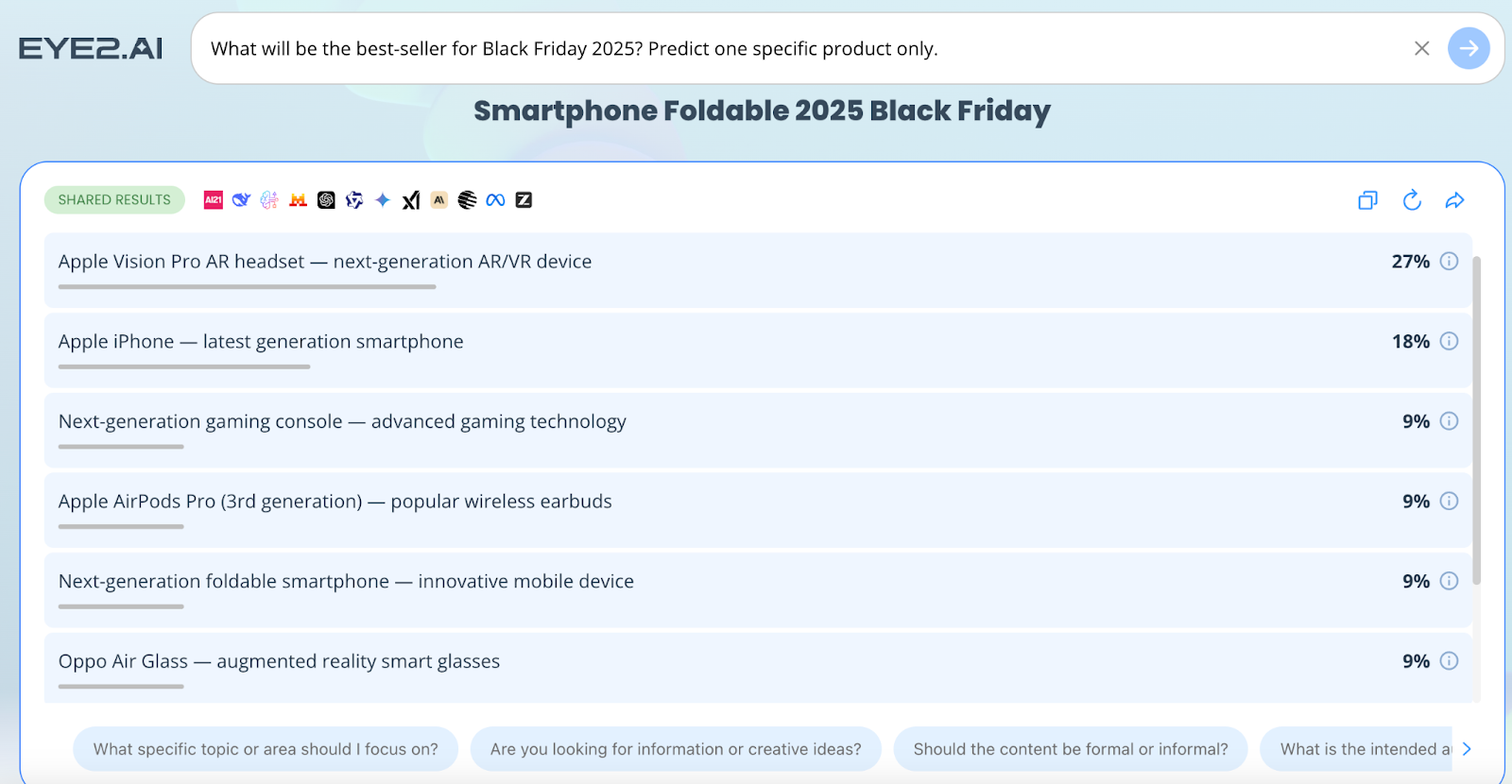
Product Prediction | Consensus Score |
Apple Vision Pro AR Headset | 27% (Top Prediction) |
Apple iPhone (Latest Gen) | 18% |
Apple AirPods Pro (3rd Gen) | 9% |
Next-Gen Gaming Console | 9% |
Oppo Air Glass | 9% |
The AIs’ Vote: Over 50% of the models believed Apple would dominate. However, the plurality (27%) bet on Apple's most expensive, niche device: the Vision Pro.
What actually happened?
The Verdict: ❌ Partial Fail.
When the sales numbers came in post-Black Friday, the "best-seller" list looked very different from the AI predictions. According to the actual sales data tracked by Eye2.AI and retail reports:
Winner: Apple AirPods Pro 2 (Discounted to £169)
Runner Up: Eufy X10 Pro Omni Robot Vacuum
Notable Mention: Oura Ring 4
The Apple Vision Pro – the AI's top pick – was nowhere near the top volume movers.
Why did the models get it wrong?
This experiment reveals a critical flaw in using AI for financial forecasting: The Hype Bias.
Training Data vs. Sales Data: LLMs are trained on text, not credit card swipes. The Apple Vision Pro generates massive amounts of text (articles, reviews, tweets) because it is novel technology.
The "Loudest" Room: Because the internet talks about the Vision Pro the most, the AI inferred it would sell the most.
The "Boring" Reality: The AirPods Pro (which only 9% of models predicted) is a "boring" staple. It doesn't generate headlines, but at a discounted price point, it generates sales.
Who was right?
The minority (9%) of models that picked AirPods Pro demonstrated a better understanding of economic reality: Lower price + High Utility = Volume Sales. The 27% that picked Vision Pro were analyzing marketing noise, not market mechanics.
What are the Pros and Cons of AI Trend Forecasting?
✅ Pros (What they got right):
Brand Dominance: The models correctly identified that 2025 was a massive year for Apple, with the top two predictions belonging to the brand.
Category Awareness: They correctly identified that wearables (Headsets, Glasses, Earbuds, Rings) would outperform traditional tech like laptops.
❌ Cons (Where they failed):
Price Blindness: The consensus failed to factor in that a premium headset rarely becomes a "mass market best-seller" compared to a sub-$200 accessory.
Specificity Drift: Predictions like "Next-generation gaming console" (9%) are too vague to be actionable for investors or retailers.
Can you trust the AI consensus?
If you had used Eye2.AI to plan your stock portfolio, betting on Apple (AAPL) generally would have paid off. But if you were a retailer stocking inventory based on the "Top Prediction," you would have been left with a warehouse full of unsold Vision Pros.
The Lesson: AIs are great at predicting what people will talk about. They are still learning to predict what people will buy.
FAQs
1. Why do AI models confuse "hype" with "sales"?
AI models are probabilistic engines trained on text frequency. If a product is mentioned 1 million times in articles (like the Vision Pro), the AI assigns it a higher "weight" or importance. It struggles to distinguish between excitement (news coverage) and utility (actual purchase intent).
2. Which specific AI model was the most accurate?
In this specific test, Claude and Gemini were part of the minority cluster that suggested "AirPods" or general "Hearables," showing a better grasp of consumer economics than the models that suggested the $3,500 headset.
3. Should I use AI for stock picking?
Never rely on a single model. As our "Oracle Test" shows, models can be confident but wrong. We recommend using Eye2.AI to find the consensus (where 3+ models agree) and treating outliers with extreme caution.
By using Eye2.ai, you agree to the Terms and Privacy Policy. Outputs may contain errors.
Download the Eye2.ai app on: