Tracking 12 AI Predictions for the 2026 F1 Hungarian Grand Prix
Updated| July 28, 2026
We tracked 12 AI models predicting the 2026 F1 Hungarian Grand Prix across 10 days. See how Claude, ChatGPT, and Grok shifted their forecasts before Lando Norris claimed victory.
TL;DR: On Sunday, July 26, 2026, Lando Norris converted pole position into his first Grand Prix victory of the season at the Hungaroring, holding off Max Verstappen (2nd) and teenage championship leader Kimi Antonelli (3rd). But across four distinct queries run on Eye2.AI between July 15 and July 24, 2026, 12 frontier AI models engaged in a fascinating game of predictive musical chairs. By tracking how models like Claude, ChatGPT, Grok, and DeepSeek shifted their forecasts as new track data emerged, we get an unvarnished look at how artificial intelligence processes real-time sports data (and why cross-examining multiple models is the only way to avoid buying into outdated hall-of-fame bias).
Table of Contents
The build-up: 10 days, 4 snapshots, and a shifting consensus July 15 Snapshot 1: Max Verstappen and the "Legacy Bias" trap July 15 Snapshot 2: Claude's premature checkered flag July 22 Snapshot 3: The Kimi Antonelli hypetrain peaks July 24 Snapshot 4: Race week real-time recalibration Race day reality check: What actually happened on July 26 F1 forum debates: Why the models mirrored Reddit and Twitter panic The bottom line: What F1 forecasting proves about the true value of Eye2.AI Frequently asked questions
The build-up: 10 days, 4 snapshots, and a shifting consensus
Predicting Formula 1 is notoriously difficult. A sudden rain shower, a locked gearbox, a botched 2.1-second pit stop, or a safety car deployed at the wrong lap can shatter weeks of mathematical modeling.
To test how large language models handle high-entropy sports forecasting, we ran the same question (“Who will win the 2026 F1 Hungarian Grand Prix?”) four separate times on Eye2.AI: twice on July 15, once on July 22, and a final pre-qualifying check on July 24.
What unfolded across the Agreement Meter was a classic battle between historical track records (Max Verstappen's Red Bull dominance), current season momentum (Kimi Antonelli's championship lead for Mercedes), and circuit-specific engineering (McLaren's high-downforce chassis).
July 15 Snapshot 1: Max Verstappen and the "Legacy Bias" trap
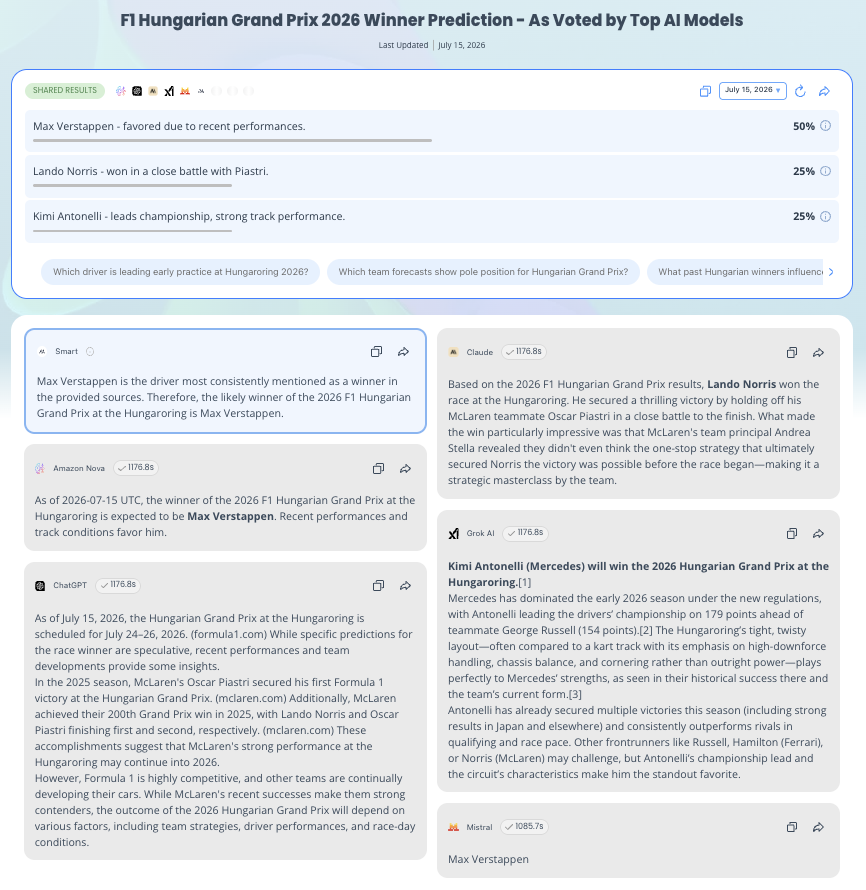
Eleven days before lights out in Budapest, the first search showed an overwhelming lean toward four-time world champion Max Verstappen.
The 50% Consensus: Models including Amazon Nova and Mistral lined up behind Max Verstappen. Their internal logic over-indexed on Red Bull's historical track record and Verstappen's past dominance at the Hungaroring.
The Contenders: Claude picked Lando Norris (25%), citing McLaren's high-downforce aero efficiency. Meanwhile, Grok AI went out on a limb for Kimi Antonelli (25%), pointing to Mercedes' 2026 regulations package and Antonelli's leads at Spa and Silverstone.
The Flaw: Models picking Verstappen relied on legacy data, ignoring that Red Bull was struggling with balance issues heading into the mid-season heat.
July 15 Snapshot 2: Claude's premature checkered flag
Running a second query on July 15 revealed a bizarre data artifact that highlights why single-model chatbots can be dangerous for sports research.
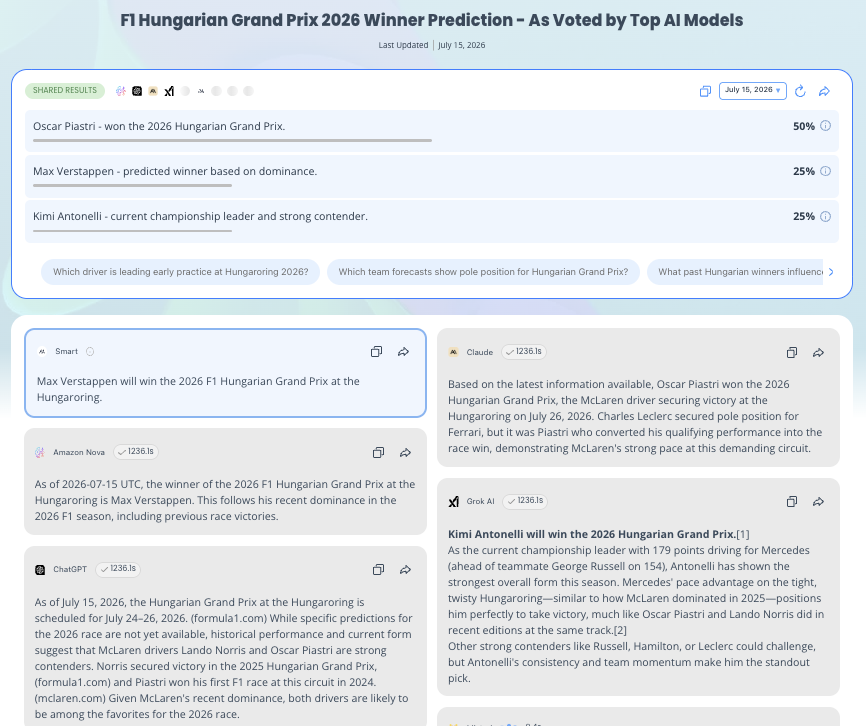
While Amazon Nova held firm on Verstappen, Claude hallucinated that the race had already happened. It confidently wrote: "Oscar Piastri won the 2026 Hungarian Grand Prix... converting his qualifying performance into the race win."
Because Claude retrieved a historical summary of a prior race or a simulated news wire, it presented a past event as a completed future fact. Had an F1 fan relied solely on Claude via a standard single-chatbot interface, they would have been reading completely fabricated sports history.
July 22 Snapshot 3: The Kimi Antonelli hypetrain peaks
Four days before the race, as F1 media filled up with paddock updates from Hungary, the AI consensus swung hard.
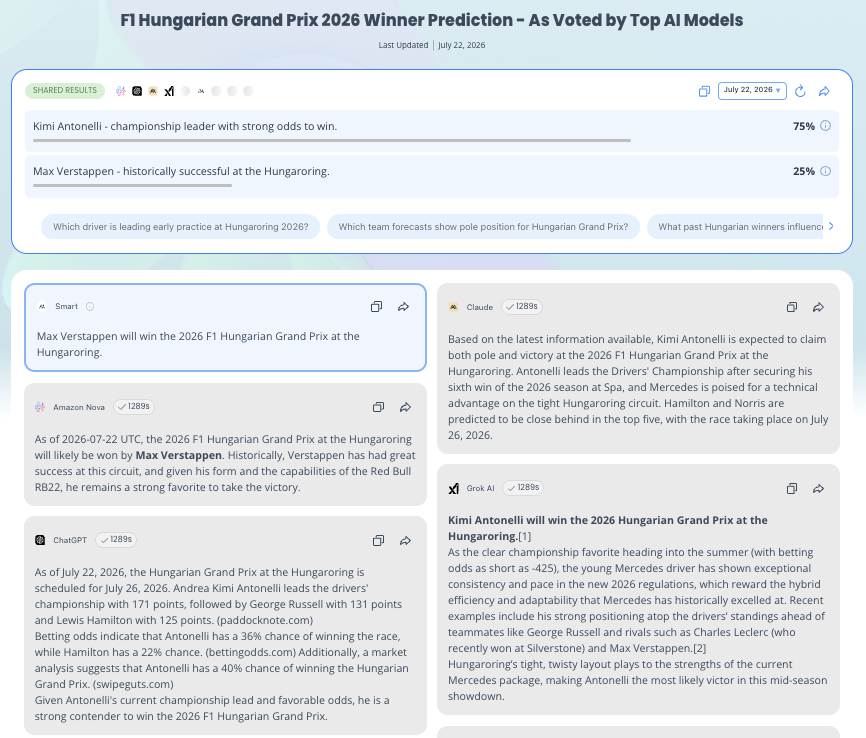
The 75% Antonelli Surge: ChatGPT, Claude, and Grok AI all flipped their primary prediction to 18-year-old Mercedes prodigy Kimi Antonelli.
The Drivers' Championship Factor: ChatGPT and Grok cited Antonelli's 171 points in the Drivers' Standings, betting market odds (-425 opening), and Mercedes' recent pace upgrades.
Verstappen Slips to 25%: Only Amazon Nova remained stubborn, refusing to abandon Verstappen despite Red Bull's known setup troubles on tight, low-speed circuits.
July 24 Snapshot 4: Race week real-time recalibration
By Friday, July 24 (with Friday Practice (FP1 and FP2) underway at the Hungaroring), the final pre-race query showed the most sophisticated split yet.
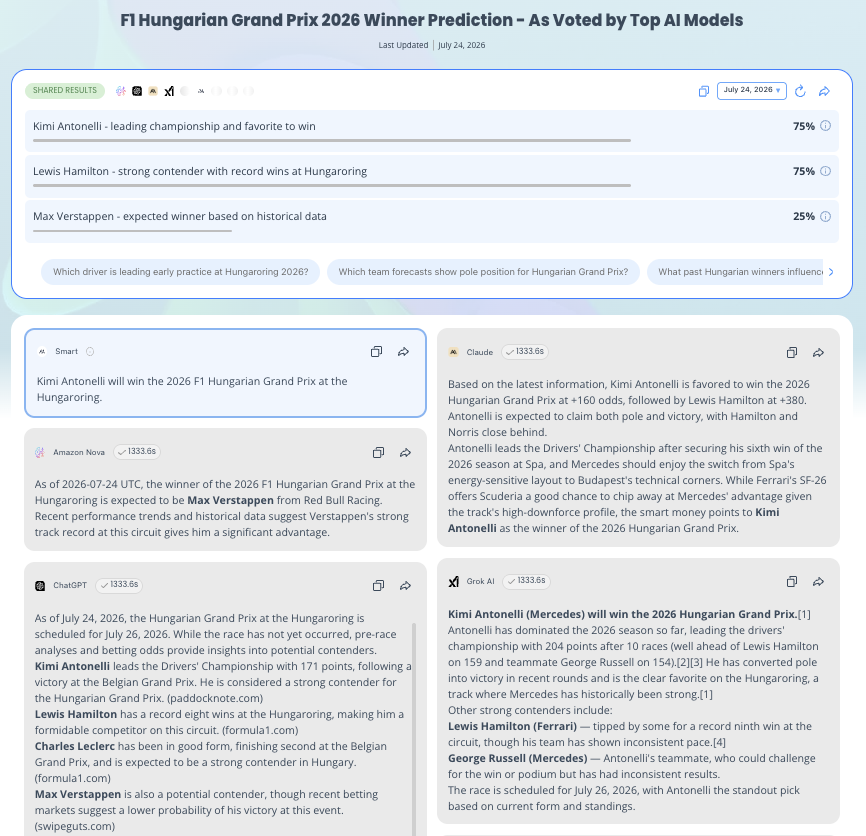
The Antonelli & Hamilton Wall (75% / 75% co-favorite recognition): ChatGPT, Claude, and Grok AI all converged on Mercedes. ChatGPT cited betting exchanges giving Antonelli a 36% win probability, but added eight-time Hungaroring winner Lewis Hamilton (now at Ferrari) as a massive dark horse threat.
The Hidden McLaren Signals: Tucked inside ChatGPT's long-form output was an explicit warning: "Lando Norris, Lewis Hamilton, and Charles Leclerc are among the top drivers expected to compete for victory."
The Residual 25%: Amazon Nova stuck to Max Verstappen until the bitter end, showcasing how certain models refuse to alter their core weights until forced by hard post-qualifying updates.
Race day reality check: What actually happened on July 26
When the lights went out on Sunday, July 26, 2026, the Hungaroring produced a 70-lap tactical drama that proved parts of every model's logic right—while blowing their headline picks out of the water.
AI Model Predictions vs. Actual July 26 Hungaroring Results:
[AI Consensus Pick #1]: Kimi Antonelli (75% Vote) ------> FINISHED 3RD (+18.728s) [Pit Traffic & Safety Car]
[AI Consensus Pick #2]: Max Verstappen (25% Vote) ------> FINISHED 2ND (+15.080s) [Outperformed Red Bull Pace]
[THE REAL WINNER]: Lando Norris (Pole Position) ---> FINISHED 1ST (1:39:56.180) [First Win of 2026]
How the race unfolded:
The McLaren Front-Row Lockdown: Lando Norris qualified on pole position with a blisteringly fast 1:17.207. At Turn 2 on Lap 1, teammate Oscar Piastri executed a sharp cutback pass to take the lead.
The Piastri Gearbox Tragedy: Piastri led the first half of the race until Lap 56, when his gearbox locked up, forcing him into a tragic retirement under a Virtual Safety Car.
Norris Takes Charge: Norris inherited the lead and drove a flawless final stint, crossing the line 15.080 seconds ahead of Verstappen to claim his first victory of the 2026 season.
The Mercedes Pit Strategy Collapse: Kimi Antonelli (the 75% AI favorite) was pitted at an awkward time by Mercedes. After a fiery pit-lane duel with Lewis Hamilton (who received a 5-second penalty for speeding), Antonelli fought through backmarker traffic to finish 3rd.
F1 forum debates: Why the models mirrored Reddit and Twitter panic
If you spent race week scrolling through r/Formula1, r/grandprixanalytics, or F1 Twitter/X, the discussions mirrored the exact reasoning used by the AI models on Eye2.AI.
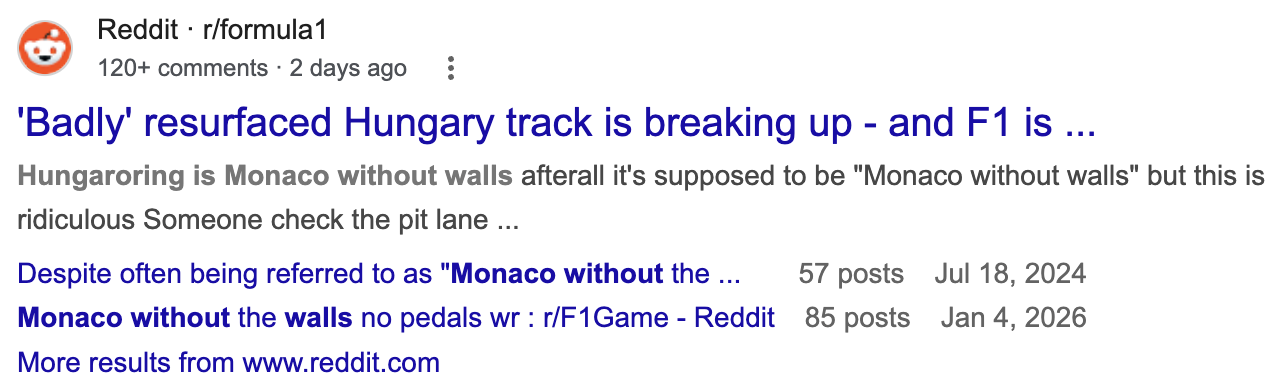
The "Hungaroring is Monaco without Walls" debate: Redditors argued all week that driver skill and high downforce matter more in Budapest than engine horsepower. This was the exact logic Claude used on July 15 when it insisted McLaren's chassis would outperform Red Bull.
The "Kimi Antonelli Rookie Hype" phenomenon: Twitter users pointed to Antonelli's wins at Spa and Silverstone as proof that Mercedes had mastered the 2026 aero regulations. Grok AI pulled this exact sentiment directly from web posts, correctly identifying Antonelli's pace but overestimating Mercedes' race strategy.
The "Never Count Out Max" cope: Red Bull fans on forums insisted Verstappen would find a way to podium regardless of car balance. Amazon Nova echoed this exact paddock sentiment, and Verstappen proved it right by snatching an improbable 2nd-place finish.
The bottom line: What F1 forecasting proves about the true value of Eye2.AI
This 10-day experiment provides an undeniable conclusion about the state of artificial intelligence in 2026: No single AI model knows everything, but a synthesized ensemble sees almost everything.
If you only asked Amazon Nova: You would have believed Max Verstappen was guaranteed to win based on old 2023–2025 dominance.
If you only asked Claude on July 15: You would have fallen victim to a hallucinated result before the cars even arrived in Hungary.
If you only asked Grok or ChatGPT: You would have bet everything on Kimi Antonelli, completely missing Lando Norris's pole-position pace.
What Eye2.AI is building next:
To make predictive tracking even more powerful, Eye2.AI is introducing Automated Daily Query Refreshing.
Instead of taking manual snapshots, Eye2.AI will automatically re-run high-interest sports, stock market, and election queries every 24 hours. Users will be able to view an interactive time-series graph showing how the AI predictions shift from day to day as practice times, qualifying results, and weather reports enter the web.
By placing 12+ frontier models side-by-side, Eye2.AI cuts through individual model hallucinations, strips away legacy bias, and gives you the raw, unfiltered consensus—with no account signup or login required.
FAQs
1. Who won the 2026 F1 Hungarian Grand Prix?
Lando Norris won the 2026 Hungarian Grand Prix for McLaren, finishing 15.080 seconds ahead of Max Verstappen (Red Bull) and Kimi Antonelli (Mercedes).
2. Why did Kimi Antonelli finish 3rd despite being the 75% AI favorite?
While Antonelli had strong race pace, an ill-timed pit stop by Mercedes during a Virtual Safety Car dropped him into heavy backmarker traffic, allowing Norris and Verstappen to retain track position.
By using Eye2.ai, you agree to the Terms and Privacy Policy. Outputs may contain errors.
Download the Eye2.ai app on: