Sinner vs. Alcaraz: Who did the AI pick to win the US Open?
Updated| September 8, 2026
We tracked 12 top AI models predicting the 2026 US Open Men's Singles champion over 5 weeks. See how predictions shifted between Jannik Sinner, Carlos Alcaraz, and Alexander Zverev.
TL;DR: Between July 30 and September 3, 2026, we tracked daily searches on
How the AI Men's US Open predictions changed over 5 weeks
Predicting the Men's Singles champion at Flushing Meadows requires balancing hard-court win rates, Masters 1000 form, physical fitness, and late-summer injury updates.
When we ran the daily query (“Who will win the 2026 US Open Men's Singles title?”) on Eye2.AI across July and August 2026, the AI models shifted through three distinct phases:
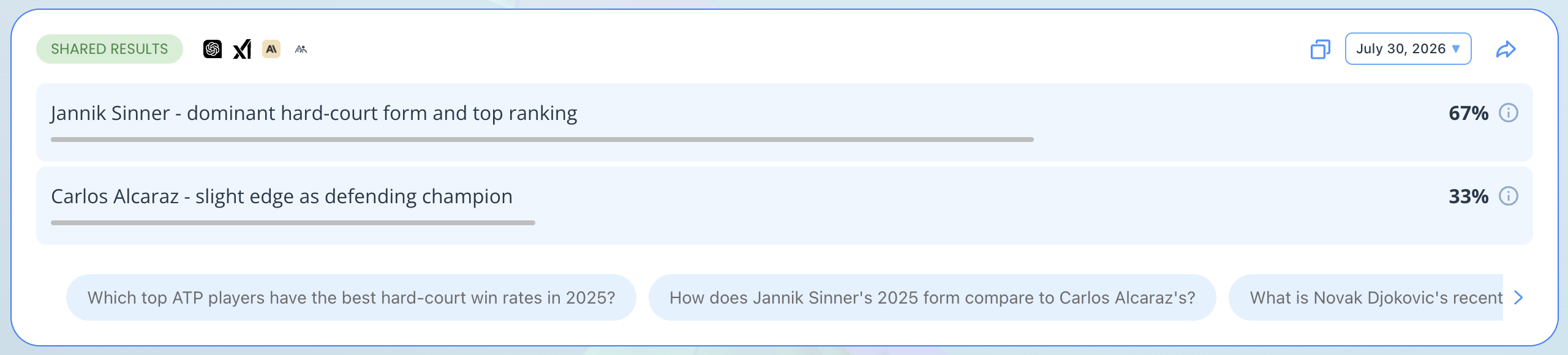
- July 30 (The Sinner Baseline): The AI models opened with Jannik Sinner taking 67% consensus, while defending champion Carlos Alcaraz held 33%. Models like Grok AI and Claude pointed to Sinner's world No. 1 ranking, his 91.1% hard-court win rate, and his Masters 1000 titles in Indian Wells and Miami.
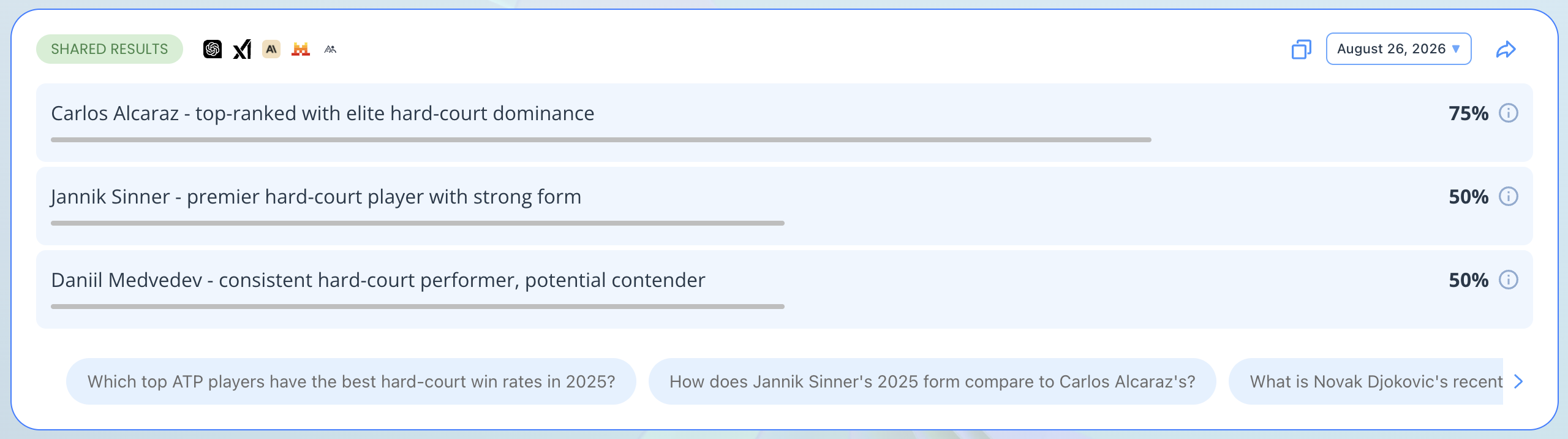
- August 26–27 (The Sinner Peak & Alcaraz Surge): By late August, Sinner reached a 100% consensus on individual model cards (Claude, Grok AI), while Alcaraz surged to 75% and Daniil Medvedev reached 75% as top contenders. ChatGPT flipped to Medvedev on August 26 before switching to Alcaraz on August 27, while Mistral pointed to Alcaraz's 48-4 season record.
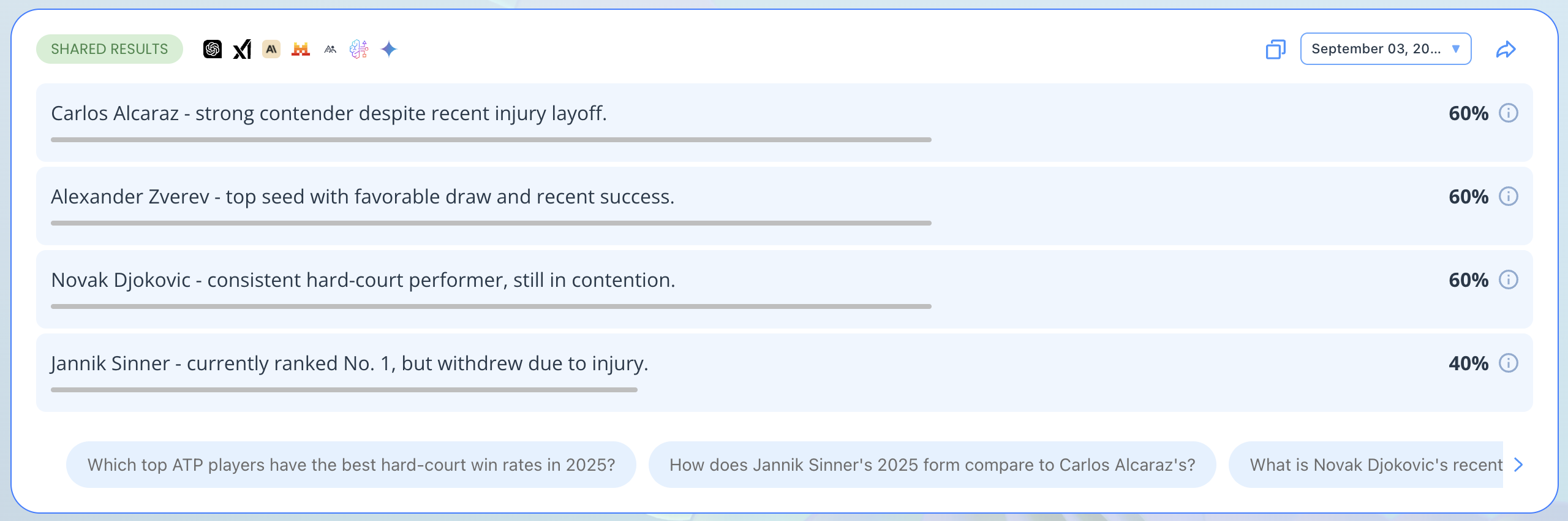
- September 3 (The Injury Shakeup): As real-time reports of Sinner's wrist injury and withdrawal surfaced alongside rumors surrounding Alcaraz, the consensus fractured. Carlos Alcaraz, Alexander Zverev, and Novak Djokovic locked into a three-way 60% split, with Sinner dropping to 40%. Claude flipped its primary pick to Zverev, while Grok AI backed Djokovic as a dark horse.
Breakdown: Daily consensus scores and model hallucination traps
The table below maps the daily top picks and model errors captured on the Eye2.AI dashboard:
| Date | AI Consensus Top Picks | Leading Model Favorites | Summary of AI Logic and Errors |
| July 30, 2026 | Jannik Sinner (67%) Carlos Alcaraz (33%) | Sinner (Grok, Claude) | Cited Sinner's No. 1 ATP ranking and 91.1% hard-court win rate. |
| August 26, 2026 | Alcaraz (75%) Sinner (50%) Medvedev (50%) | Alcaraz (Mistral) Medvedev (ChatGPT) | ChatGPT picked Medvedev; Mistral called Sinner a "rising star who lacks Grand Slam experience." |
| August 27, 2026 | Sinner (100%) Alcaraz (75%) Medvedev (75%) | Sinner (Grok, Claude) Alcaraz (ChatGPT, Mistral) | Sinner reached 100% consensus across primary model cards; Mistral hallucinated fake early-round match draws. |
| September 3, 2026 | Alcaraz (60%) Zverev (60%) Djokovic (60%) Sinner (40%) | Alcaraz (Grok, Mistral) Zverev (Claude) Djokovic (Amazon Nova) | Predictions split wide due to Sinner's injury news; Gemini incorrectly claimed Sinner won Wimbledon. |
Behind the logic: Hard-court stats vs. injury news and fake draws
1. The Stat-Grounded Models: Grok AI and Claude
2. The Hallucination Traps: Mistral and Gemini
- On August 27, Mistral claimed Sinner "lacks experience for a Grand Slam" despite Sinner already being a proven Grand Slam champion.
- Mistral also made up early-round match draws, listing potential matchups like "Alcaraz vs. Kyle Edmund" (Edmund retired from singles competition).
- On September 3, Gemini claimed Sinner won Wimbledon for the second consecutive year, confusing real-world grass-court results.
3. The Sudden Shifts: ChatGPT and Claude
Why multi-model verification helps sports fans and analysts
If a tennis fan queried a single AI tool in late August, they might have read that Sinner lacked Grand Slam experience or relied on fake early-round match draws.
Using
- Spot Hallucinations Instantly: The Shared Results shows where top models agree on ATP statistics versus where individual models hallucinate fake match records.
- Track Live Odds & Injury Shifts: Watch how injury updates (like Sinner's wrist news) immediately shift model votes from a 100% lock to a 3-way split.
- 100% Private Research: Compare 12+ top AI models side-by-side with no account creation, no login, and zero tracking cookies.
FAQs
1. Which player was the top AI favorite to win the 2026 US Open Men's title?
Jannik Sinner started as the 67% favorite on July 30 and reached a 100% consensus card vote on August 27. However, injury updates on September 3 caused predictions to split into a 60% tie among Carlos Alcaraz, Alexander Zverev, and Novak Djokovic.
2. Why do AI models make mistakes about tennis rankings and draws?
Models without live search access rely on older training text. When asked about upcoming Grand Slam draws, ungrounded models sometimes invent matchups using retired players or mix up past tournament results.
3. How do I test US Open predictions on Eye2.AI?
Type your matchup question into the search bar at
By using Eye2.ai, you agree to the Terms and Privacy Policy. Outputs may contain errors.
Download the Eye2.ai app on: