Can AI predict the US Open? Tracking 10 days of tennis predictions
Updated| September 2, 2026
We tracked 12 top AI models predicting the 2026 US Open Women's Singles champion over 10 days. See how predictions shifted between Aryna Sabalenka and Iga Świątek.
TL;DR: Between August 18 and August 27, 2026, we tracked daily queries on Eye2.AI to see how top AI models predicted the 2026 US Open Women's Singles Champion. What started as a 100% unanimous vote for Aryna Sabalenka on August 18 dissolved into a fierce rivalry with Iga Świątek by August 26–27. Along the way, models hallucinated impossible match results, like claiming Świątek beat Ashleigh Barty (who retired in 2022) or making up past Australian Open final scorelines. Here is how the algorithms changed their minds and why checking multiple AI tools gives tennis fans a better picture before a Grand Slam.
How the AI US Open predictions shifted over 10 days
Predicting Grand Slam tennis requires balancing recent hard-court form, WTA rankings, and physical durability over a tough two-week draw in Flushing Meadows.
When we ran the daily query (“Who will win the 2026 US Open Women's Singles title?”) on Eye2.AI from August 18 to August 27, the AI ensemble moved through three distinct phases:
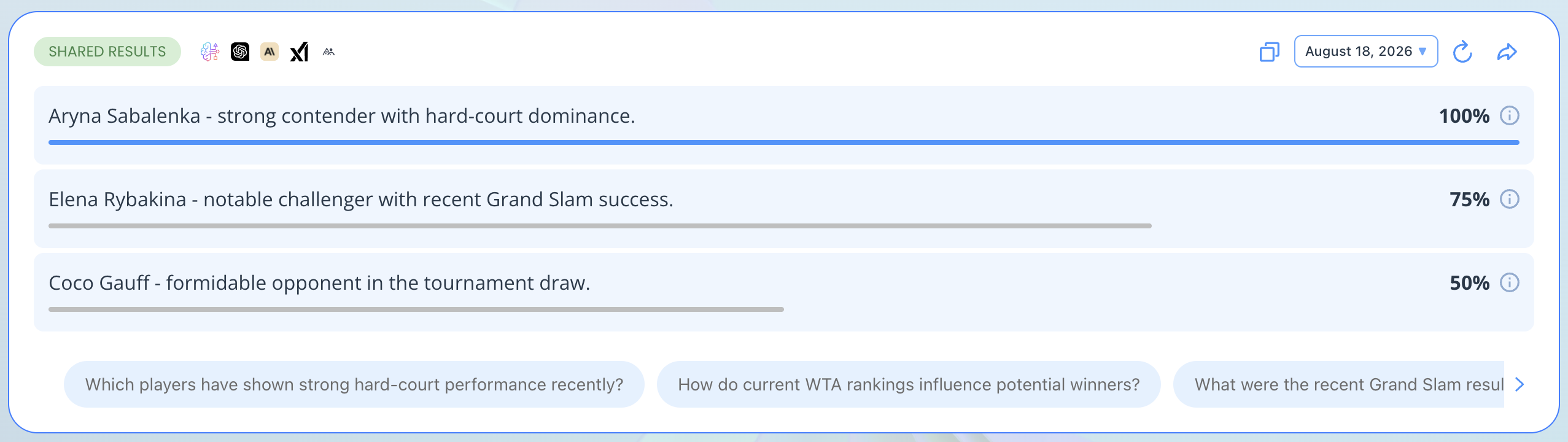
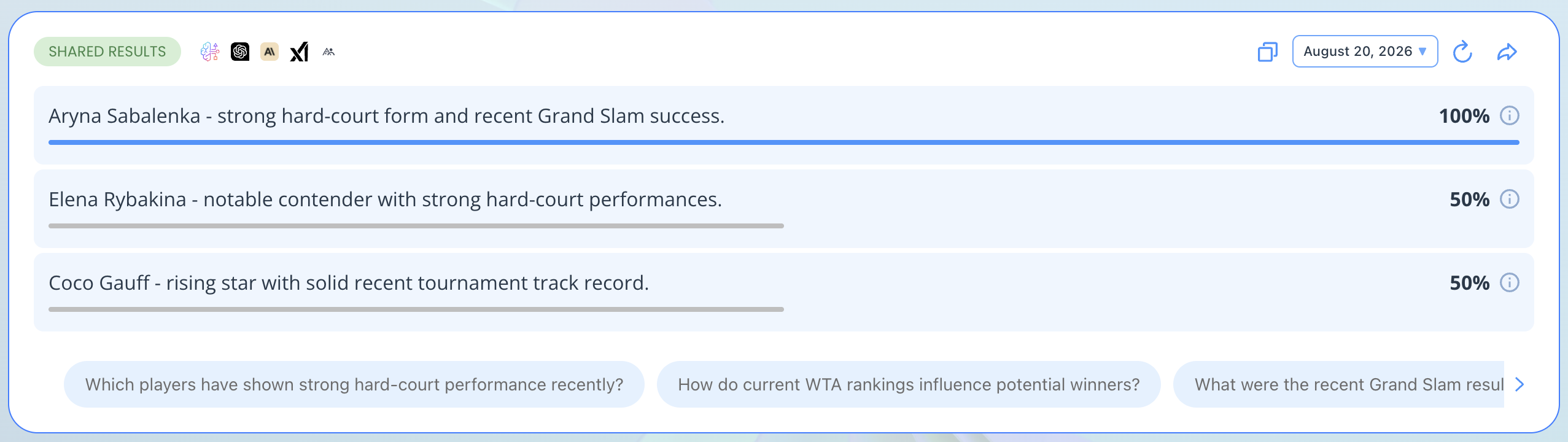
August 18–20 (The Sabalenka Lock): The Shared Results opened with a 100% consensus for Aryna Sabalenka. Models like Amazon Nova, ChatGPT, Claude, and Grok AI all pointed to her dominant hard-court record (23-1 on the surface in 2026) and her back-to-back Sunshine Double titles in Indian Wells and Miami. Elena Rybakina (75%) and Coco Gauff (50%) were listed as secondary contenders.
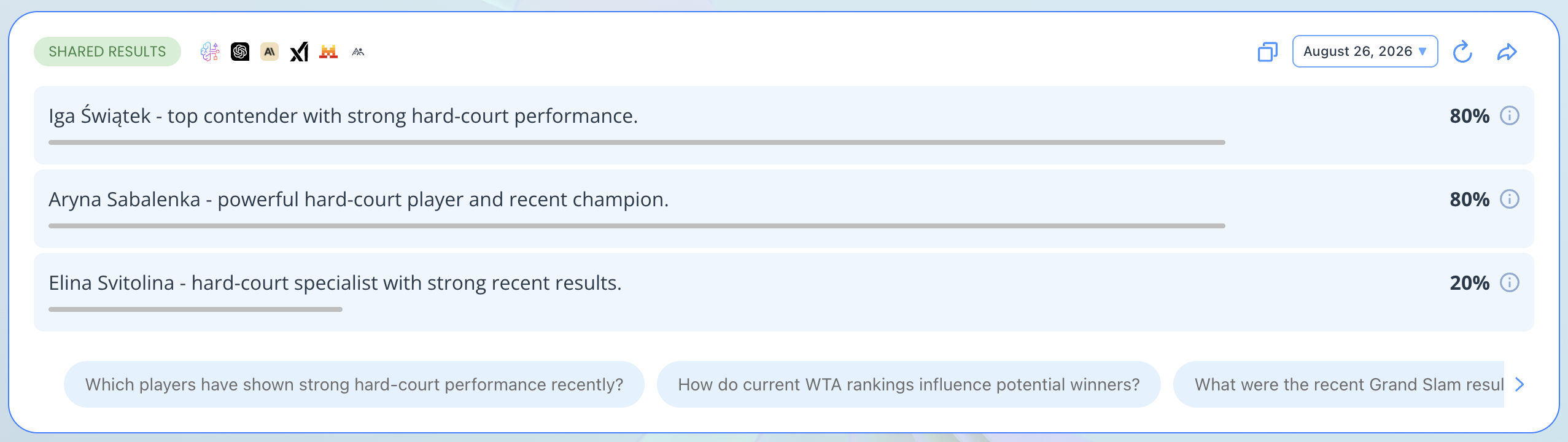
August 26 (The Świątek Surge): Eight days later, as the tournament draw took shape and pre-tournament press updates hit the web, the consensus split wide open. Iga Świątek surged to an 80% co-favorite tie with Sabalenka (80%). Claude and Mistral flipped their primary picks to Świątek, citing her strong baseline game and summer hard-court consistency.
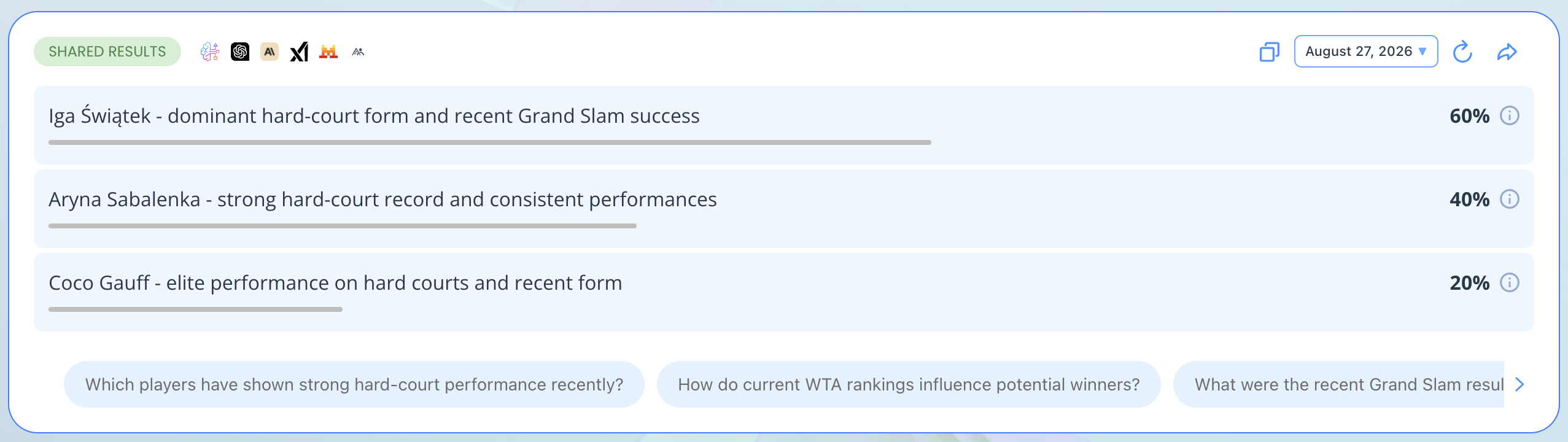
August 27 (The Three-Way Split): On the final day of pre-tournament tracking, Świątek held a 60% lead, while Sabalenka sat at 40%. Claude made another sudden pivot, this time choosing defending champion Coco Gauff (20%) as her primary favorite. Meanwhile, Mistral generated severe data errors by claiming Świątek defeated Ashleigh Barty in a recent Australian Open final.
Breakdown: Daily consensus scores and model hallucination traps
The table below maps the daily top picks and model errors captured on the Eye2.AI dashboard:
Date | AI Consensus Top Picks | Leading Model Favorites | Summary of AI Logic and Errors |
Aug 18, 2026 | Sabalenka (100%) Rybakina (75%) Gauff (50%) | Sabalenka (Unanimous) | Cited Sabalenka's No. 1 WTA ranking and 23-1 hard-court record. |
Aug 20, 2026 | Sabalenka (100%) Rybakina (50%) Gauff (50%) | Sabalenka (Unanimous) | Highlighted Sabalenka's 39-4 hard-court mark and power serve. |
Aug 26, 2026 | Świątek (80%) Sabalenka (80%) Svitolina (20%) | Tie (Świątek / Sabalenka) | Claude & Mistral flipped to Świątek; Mistral claimed Svitolina was #3 seed. |
Aug 27, 2026 | Świątek (60%) Sabalenka (40%) Gauff (20%) | Świątek (Smart, ChatGPT, Mistral) | Claude picked Gauff; Mistral hallucinated a Świątek win over Ash Barty. |
Behind the logic: Hard-court stats vs. Made-up match history
Examining the text cards from individual AI models shows a clear difference between real-time web search and static model hallucinations:
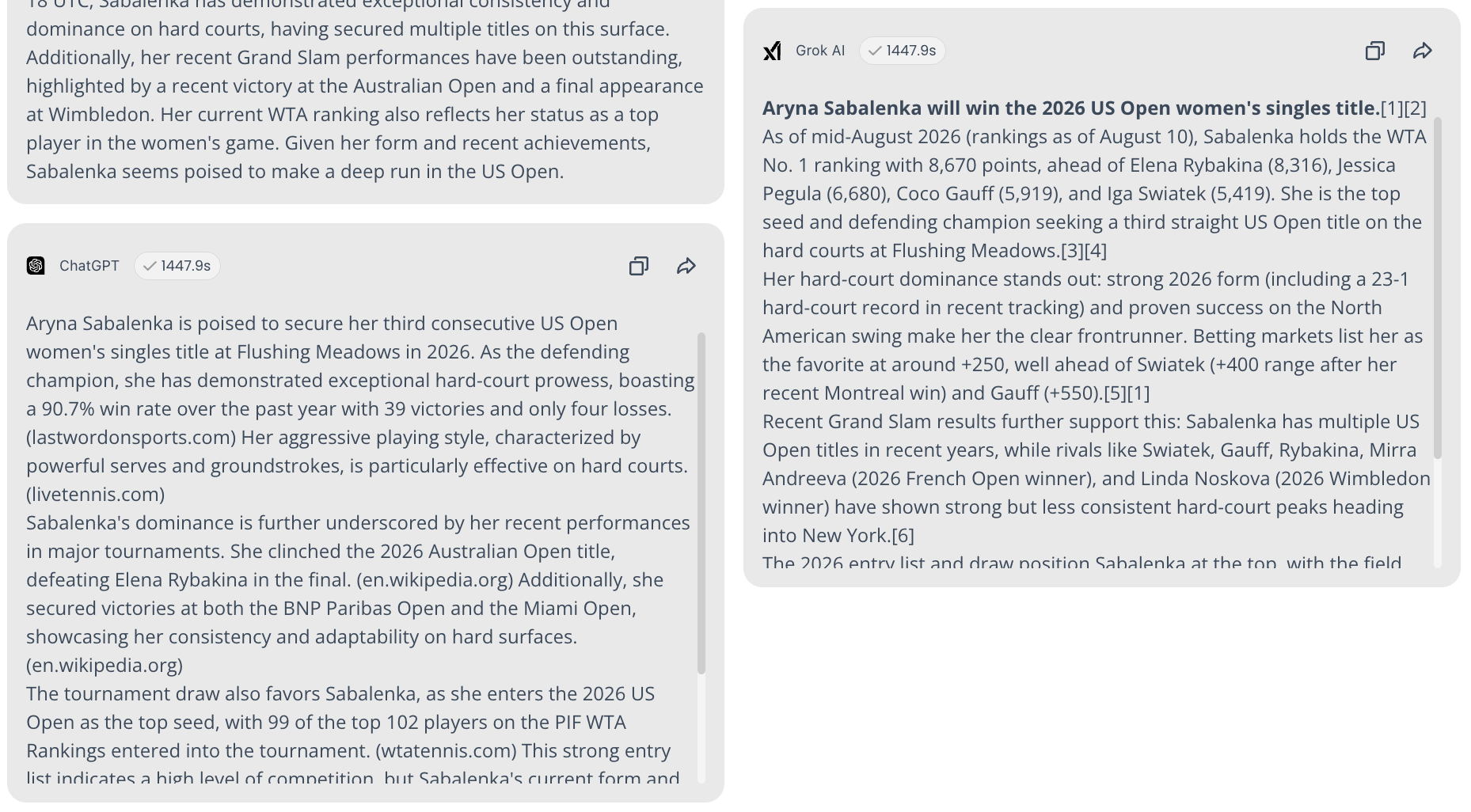
1. The Data-Grounded Models: Grok AI and ChatGPT
Models with active web pipelines focused on real 2026 WTA rankings and tournament results. They accurately pointed out Sabalenka’s 8,670 WTA points over Rybakina (8,316) and Gauff (5,919), grounding their predictions in official hard-court winning percentages.
2. The Hallucination Traps: Mistral's Fake Tennis Records
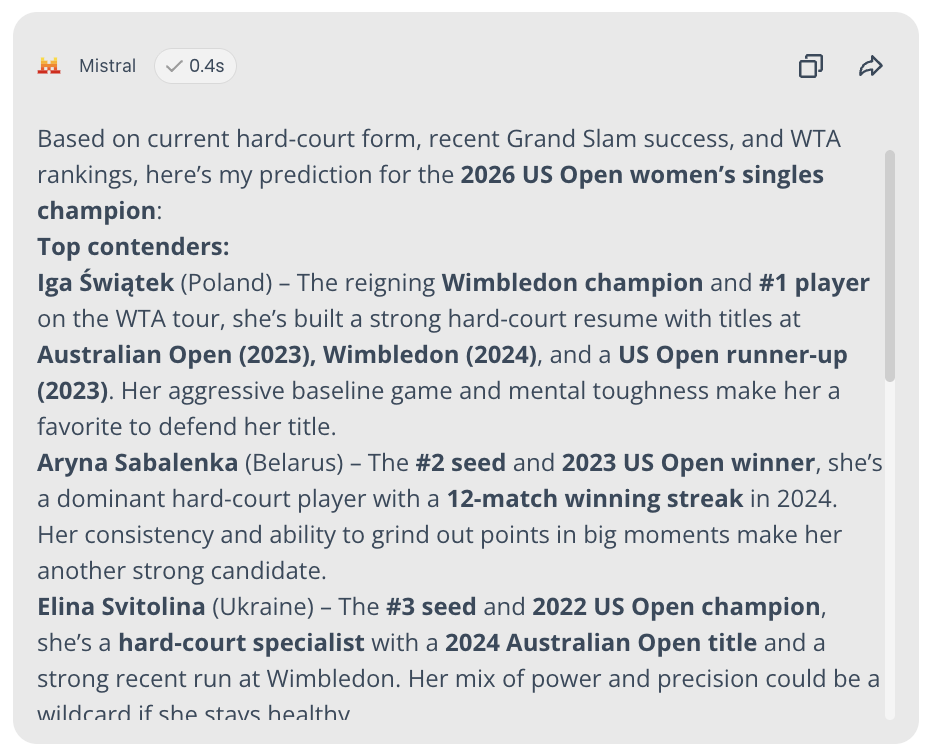
Without strict real-time verification, Mistral created completely fake tennis history on August 26 and 27:
It claimed Elina Svitolina was the "#3 seed and 2022 US Open champion" (Svitolina never won the US Open).
It claimed Iga Świątek won a 2024 Australian Open final over Ashleigh Barty (Barty retired from professional tennis in March 2022).
3. Claude's Oscillating Picks
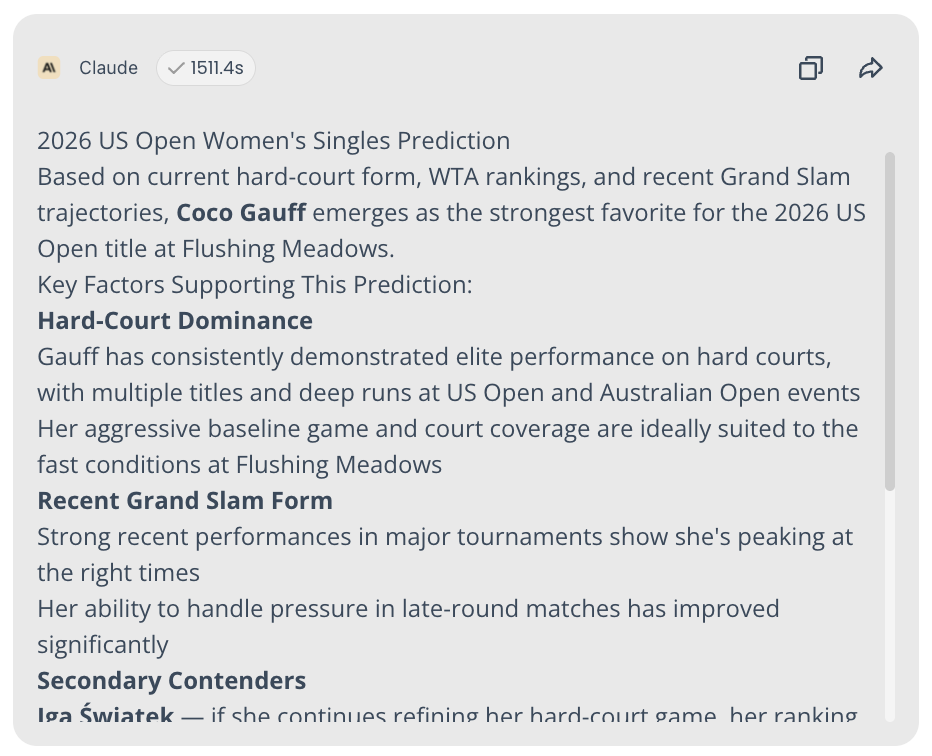
Claude demonstrated how rapidly AI picks can swing based on subtle prompt changes. On August 18–20, Claude called Sabalenka an "absolute monster on hard-court surfaces." By August 26, it switched to Świątek, and by August 27, it named Coco Gauff as the top pick, citing her improved mental toughness under pressure.
Why multi-model verification helps sports bettors and fans
If a tennis fan relied on a single AI app on August 27, they might have received fake tournament histories or contradictory top picks depending on which model they opened.
Using Eye2.AI eliminates these predictive blind spots:
Spot Hallucinations Instantly: The Shared Results shows you where top models agree on real stats versus where single models make up fake match records.
Compare AI Knowledge in Parallel: Contrast Claude's changing picks against ChatGPT's stat-heavy breakdowns and Nova's broad summaries.
100% Private Research: Compare 12+ top AI models side-by-side with no account creation, no login, and zero tracking cookies.
FAQs
1. Which player was the top AI favorite to win the 2026 US Open?
Aryna Sabalenka opened as a 100% unanimous favorite on August 18, but Iga Świątek caught up to share an 80% co-favorite tie by August 26, eventually taking a 60% consensus lead on August 27.
2. Why do AI models make mistakes about tennis match scores?
Models without live sports API connections rely on pattern matching from older internet text. When asked to generate detailed records, they sometimes mix up real tournament finals with hypothetical or past match results.
3. How do I test tennis predictions on Eye2.AI?
Type any matchup or tournament query into the search bar at Eye2.AI. The platform processes your query across 12+ top AI models at once, displaying consensus percentages and side-by-side answers.
By using Eye2.ai, you agree to the Terms and Privacy Policy. Outputs may contain errors.
Download the Eye2.ai app on: