When will the world end? Here is what top AI models say
Updated| August 5, 2026
We asked 12 top AI models when the world will end. Discover how the algorithms compare ancient doomsday prophecies, climate risks, and astronomical guarantees.
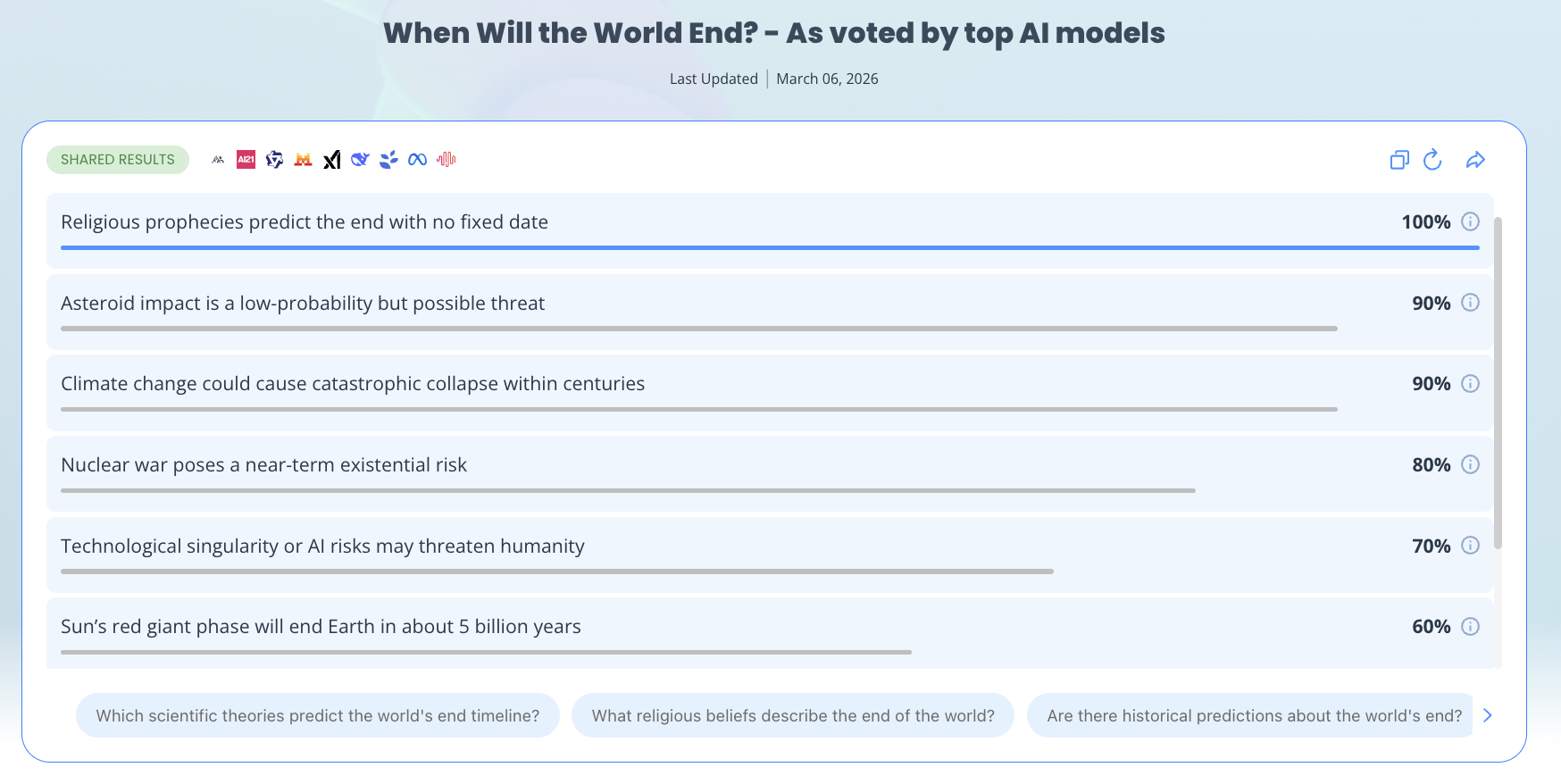
TL;DR: Ask a dozen humans when the world will end, and you will get answers ranging from ancient prophecies to modern climate anxiety. When we ran this query across top AI models on Eye2.AI, the results showed a fascinating split: a 100% consensus that religious prophecies predict an end date with no fixed calendar timeline, a 90% agreement on existential scientific threats like asteroid impacts and climate tipping points, and a 60% consensus on the ultimate cosmological guarantee (the Sun expanding into a red giant in 5 billion years).
Table of Contents
Sorting through human apocalypse theories: Religion vs. science Comparison Matrix: How top AI models group doomsday timelines Near-term risks versus distant cosmic guarantees Why multi-model synthesis cuts through viral doomsday panic Frequently asked questions
Sorting through human apocalypse theories: Religion vs. science
When evaluating apocalyptic queries, LLMs naturally group predictions into two distinct categories: cultural/spiritual frameworks and measurable scientific models.
Faith and prophecy: Models like Mistral, LLaMA, and MiniMax highlighted major religious traditions—including Christian eschatology, Islamic prophecy, and Hindu cosmic cycles (such as the Kali Yuga). Across all frameworks, the algorithms noted that traditional texts focus on signs or spiritual transitions rather than setting specific calendar dates.
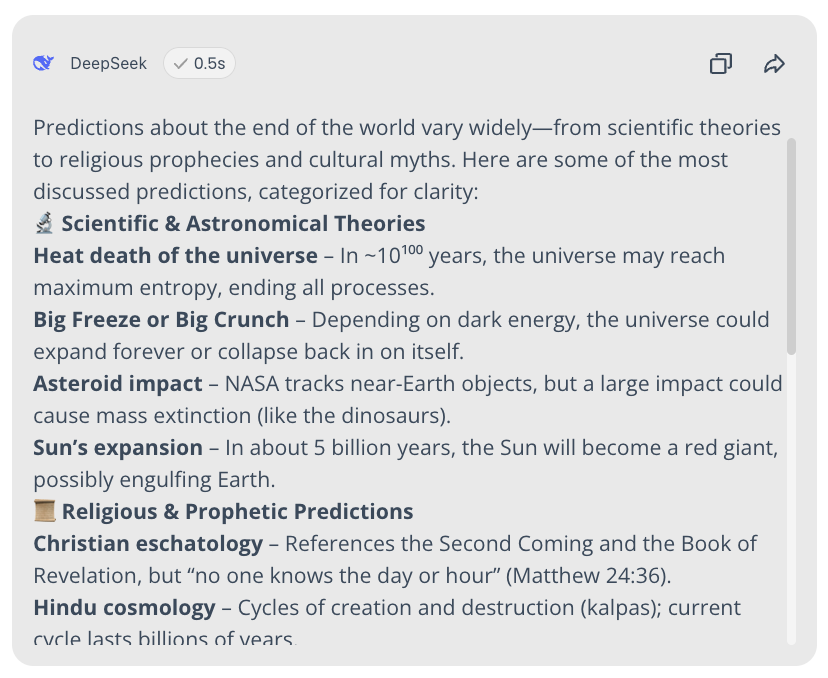
Astrophysics and geology: Models including DeepSeek, Qwen, and Cohere focused on physical planetary lifespans. They pointed to the Sun's eventual transition into a red giant in roughly 5 billion years, which will boil the oceans and swallow Earth's orbit entirely.
Comparison Matrix: How top AI models group doomsday timelines
Synthesizing the output cards from Eye2.AI reveals clear consensus levels across different doomsday scenarios:
| Doomsday Scenario | Consensus Level | Primary Model Reasoning & Context |
| Religious Prophecies | 100% | Predicts spiritual end-times tied to signs, but with no fixed calendar date. |
| Asteroid Impact | 90% | Low annual probability, but statistically inevitable over millions of years. |
| Climate Collapse | 90% | Human-driven risk that could trigger societal tipping points within centuries. |
| Nuclear War | 80% | Near-term existential threat dependent entirely on human political tension. |
| AI / Singularity Risks | 70% | Emerging technological threat highlighted by futurists and alignment researchers. |
| Sun's Red Giant Phase | 60% | Ultimate astronomical guarantee; Earth becomes uninhabitable in ~5 billion years. |
Near-term risks versus distant cosmic guarantees
Beyond billions-of-years astronomical timelines, the models flagged several human-driven and environmental risks that carry near-term weight.
The 2100 climate horizon: Models like Grok AI explicitly cited IPCC climate projections, warning that unchecked environmental changes and permafrost thawing could cause severe societal disruption within this century.
Near-Earth objects: Grok AI also highlighted NASA tracking of near-Earth objects, noting statistical risks like asteroid Apophis in 2029 (while clarifying that NASA expects it to safely pass Earth).
The technological singularity: Models like AI21 noted growing concerns among computer scientists that uncontrolled artificial intelligence or synthetic biological threats represent self-created existential risks.
Why multi-model synthesis cuts through viral doomsday panic
From the 2012 Mayan calendar craze to viral social media hoaxes, doomsday theories spread quickly when people rely on a single unverified source.
Querying a single chatbot can sometimes yield dramatic or overly narrow answers.
By displaying outputs from ChatGPT, Claude, Gemini, DeepSeek, and Grok side-by-side, the platform instantly separates viral pseudoscience from peer-reviewed scientific consensus. You get a balanced, multi-perspective view of complex questions (with no account creation or login required).
FAQs
1. According to science, when will the Earth actually end?
In about 1 billion years, increasing solar luminosity will heat the Earth enough to evaporate the oceans. In about 5 billion years, the Sun will expand into a red giant and likely engulf the planet entirely.
2. Did the Mayan calendar predict the end of the world in 2012?
No. As models like Mistral and LLaMA pointed out, December 21, 2012, simply marked the end of a 5,125-year cycle (the Long Count) in Mayan calendar tracking, not an apocalyptic prophecy.
3. How do I run complex science and philosophy queries on Eye2.AI?
Type your question directly into the
By using Eye2.ai, you agree to the Terms and Privacy Policy. Outputs may contain errors.
Download the Eye2.ai app on: